Granny's Country Store > Home-Building Resources > Stone Masonry | Search | View Cart
Stone Masonry Construction
A Brief Overview
by Thomas J. Elpel, Author of Living Homes

      Traditional Dry-Stack Stone Walls: Stone masonry originated with dry-stacked stonework where the walls are carefully layed up without mortar. Gravity serves as the glue that holds everything together. Free-standing dry-stack stone walls are usually made larger at the base and then taper in slowly as the height increases. For absolutely no expense but the labor, farmers built miles upon miles of stone fences this way in Ireland and in the northeastern states.

      Many old Irish houses were built in a similar way. Where "mortar" was used, it was often merely mud or limestone plasters with little strength. The mortar functioned as caulking to stop the flow of air, rather than as cement to bond the stones together. Short, dry-stacked stone walls are especially ideal for landscaping projects. Taller walls require more skill and time. For more details on dry-stack stone walls, be sure to check out Building Stone Walls and Stonework: Techniques and Projects.

      Traditional Mortared Stone Walls: Mortared stone walls evolved out of dry-stack stone work with the emergence of cement mortars. The first cements were made of burnt gypsum or lime mixed with water to make a paste with slight bonding capability. Stone walls still had to be built as carefully as they were without mortar. The cement paste just filled the gaps between the stones and cured to form a soft, rock-like substance.

      The basic formula for modern cement originated in England in 1824. It is called "Portland cement" because the color is similar to the rocks on the English island of Portland. It is still called Portland cement everywhere in the world it is manufactured. This cement is made with calcium from limestone or chalk, plus alumina and silica from clay and shale. The ingredients are ground, mixed in the right porportions and burnt in a kiln at a temperature of about 2500 degrees F (1350ĒC) to drive out water bound up in the raw materials. In the kiln it fuses into chunks called clinker. It is cooled and powdered, and gypsum is added to control how fast it sets up. Portland cement is mixed with sand and water, and often lime to make a smooth mortar for stone and brick work. Adding the lime makes the mortar softer and more flexible.

      With the aid of Portland cement it is possible to build a taller stone wall that does not taper inward like a dry-stacked wall. The cement has some ability to "glue" a stone wall together with less care, but proper stoneworking techiques are still important. Building a free-standing stone wall is a true art and requires a lot of time and skill to do it well. For more details on traditional mortared stone walls, be sure to check out Building with Stone.

      Veneered Stone Walls: Most stonework today consists of a non-structural veneer of stone against a structural wall of concrete or cinderblock. Concrete consists of Portland cement mixed with sand, gravel and water. The larger particles of gravel interlock like little fingers to make the concrete resistant to cracking. Steel reinforcing bar can be added to serve as much longer "fingers" to make a wall that is very resistant to cracking. Concrete is a fast and relatively inexpensive way to put up a structural wall, so few people take the time for labor intensive traditional mortared stone walls any more.

      Instead, the structural wall is put up first, and thin, flat stones are essentially glued onto the face of the wall with cement mortar. Metal tabs in the structural wall are mortared in between the stones to tie everything together, otherwise the stonework would just peel right off the wall. The structural wall serves as a form on one side of the wall to make it really easy to lay up the stonework, provided the rocks have good flat edges to work with.

      Slipform Stone Walls: A slipformed wall might be described as a cross between traditional mortared stone wall and a veneered stone wall. This is the method of stone masonry we have used the most. Short forms, up to two feet tall, are placed on both sides of the wall to serve as a guide for the stone work. You place stones inside the forms with the good faces against the form work and pour concrete in behind the rocks. Rebar is added for strength, to make a wall that is approximately half concrete and rebar and half stonework. The wall can be faced with stone on one side or both sides. With slipforms it is easy even for the novice to build free-standing stone walls.


Stone Masonry Books & Videos

Living Homes
Stone Masonry, Log, and Strawbale Construction
Building Your High-Efficiency Dream Home on a Shoestring Budget
by Thomas J. Elpel

      Living Homes includes in-depth coverage of slipform stone masonry, building an efficient masonry fireplace, measuring and mixing concrete, footings and foundations, plus tilt-up stone masonry construction. Stone masonry coverage is together throughout the book with all other aspects of building, from innovative foundation solutions to creative roofing ideas, solar design, heating, plumbing and wiring. For complete details on the book, please go to: Living Homes: Stone Masonry, Log, and Strawbale Construction

Living Homes: Integrated Design & Construction    $30.00    Quantity:

-Please scroll down the page for the "Add to Order" button.-


Slipform Stone Masonry
DVD Companion to
Living Homes: Stone Masonry, Log, and Strawbale Construction

      Want to build a stone house? It's easier than you might think! Our Slipform Stone Masonry DVD brings to life the nuts-and-bolts of the slipforming process featured in Tom's book Living Homes.

      Slipforming is the process of using forms on both sides of the wall as a guide for the stonework. The forms are filled with stone and concrete, then "slipped" up the walls to form the subsequent levels. Slipforming makes stone work easy even for the novice.

      In this unique video, Thomas J. Elpel and Robert Taylor build an insulated workshop out of stone, demonstrating the building process from site excavation right through to putting the roof on and finishing the inside. Working through the month of June in Montana, they brave the rain and snow, gusting winds, searing heat and stunning rainbows to bring this project to fruition.

      The video is designed as a companion to Tom's book Living Homes. The principles of design and construction are out-lined in the book, enabling the reader to create dwellings customized to their own unique situations. In this video you will see just one application of those principles, but in vivid detail from start to finish. With both the book and the video you too will be able to design and build in a way that is completely unique to your own Vision.

      November 2001. 1 hr. 50 min. DVD $25.00. For additional details on the workshop we built, please click here.

Slipform Stone Masonry DVD    $25.00 Quantity:

-Book + Video Discount-
Order Living Homes with the Slipform Stone Masonry DVD and save $10.00.

Living Homes + Slipform Stone Masonry DVD    $45.00    Quantity:

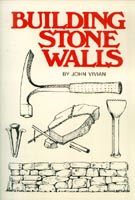
Building Stone Walls
by John Vivian

      Building Stone Walls shows you everything you need to know to build sturdy mortarless (dry-stacked) stone walls for landscaping. Learn how to make either free-standing stone walls or stone retaining walls, plus how to build a proper foundation. Coverage also includes: how to find good rock, how to build seats, steps and gates into a wall, and how to make a morterless stone birdbath, plus diversions or dams in a stream. Carefully detailed, clear drawings show the techniques to follow--and how to avoid problems. First published in 1976, the material covered in this book is just as timeless as stone itself. 108 pages. $12.00

Building Stone Walls    $12.00    Quantity:

-Please scroll down the page for the "Add to Order" button.-


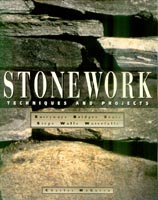
Stonework
Techniques and Projects
by Charles McRaven

      No building material rivals stone for beauty, permanence, and enduring popularity. Discover the lasting statisfaction of working with stone and learn the tricks of the trade from a master craftsman. Builder Charles McRaven offers the benefit of his fifty years of stonework experience in Stonework, a book that will inform, entertain and inspire anyone using or working with stone.

McRaven helps even first -time buiilders comprehend the intricacies of working with different stone types, including sandstone and quartzite, limestone, granite and greenstone, shale, slate and other stones. He covers how to choose the most suitable stone and where to locate natural or commercial sources of stone, including recycled stone, plus cutting and shaping stone and handling and safety issues

Featured projects include how to build a stone wall with and without mortar, plus curved walls, arches (with and without mortar), and using stone for gardens, paths, pools, waterfalls, landscape accents, pillars, gateways, doorways, stone steps, even bridges and entryways. 1997. 183 Pages. $19.00

Stonework: Techniques and Projects    $19.00    Quantity:

-Please scroll down the page for the "Add to Order" button.-


Building with Stone
by Charles McRaven
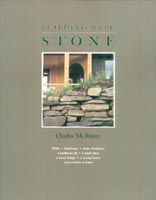
      Concrete and steel may weight as much, but nothing can rival stone for its beauty and durability. Building With Stone is an introduction to the art and craft of creating stone structures and projects by a man who has made stonework his vocation. In this book the author covers some similar techniques and projects as in his book Stonework: Techniques and Projects (see above), but he goes into greater depth with mortared wall systems and buttresses, detailing the traditional techniques of hand-layed stone for building anything from a barbecue pit to bridges, houses, or barns.

      Throughout the book is Charles McRaven's stonebuilding philosophy--that careful craftsmanship and time well spent during construction will repay itself many times over. The physical challneges will be offset by tremendous satisfaction and the knowledge that long after the builder is gone, the structure will continue to serve.

      Based on years of experience, this book will educate the novice and inspire the seasoned artisan. A stone builder at any level will learn how to evaluate each stone and undertake each step in the procedure with and eye toward aesthetics and useful permanence. The final chapter covers proper restoration techniques for stone structures. 1980, 1989. 192 Pages.

Building with Stone    $18.00    Quantity:

-Please scroll down the page for the "Add to Order" button.-


Stone House
A Guide to Self-Building with Slipforms
by Tomm Stanley
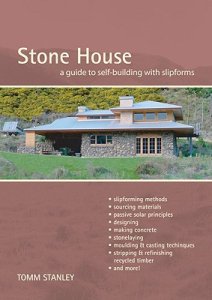
      Born and raised in the USA, author Tomm Stanley hopped around the world working in Antarctica, Australia, southeast Asia and New Zealand, where he found a partner and settled down. Tomm and Sabrina had lots of rocks available on their land, and so slipforming was the obvious choice for building their dream home.

      The slipforming method they used is largely to early slipforming methods used in North America, with one significant improvement: Instead of wire ties to hold the forms together, Stanley ran threaded rod through plastic sleeves, and used wingnuts on the outside of the forms to tighten the forms. The plastic sleeves stayed in the wall, but the threaded rod could be used again and again.

      This book is most appropriate for builders in mild climates since Stanley used only the thermal mass of the walls to moderate hot and cold temperature extremes, much like adobe houses in the southwest. There is no insulation in the walls to moderate more extreme climates, such as here in frigid Montana.

      The author uses both Imperial and metric measurements in the book, which makes it useful to readers anywhere. More importantly, Stanley emphasizes a planning method where rooms are designed to utilize standard-size building materials without much cutting and fitting.

      Stanley has an informal dialogue style of writing, which includes his thoughts, philosophy and stories along the way. He includes coverage of passive solar principles for mild climates, plus how to make a house fit the landscape. Also included are sections on moulding and casting techniques, with some coverage of working with recycled windows and doors, plus paint stripping and wood finishing. Revised and expanded edition, 2009. ISBN: 978-0-473-14821-8. 200 pages.

Stone House: A Guide to Self-Building with Slipforms    $35.00    Quantity:

-Please scroll down the page for the "Add to Order" button.-


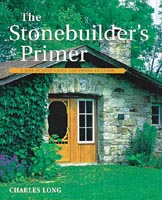
The Stonebuilder's Primer
A Step-by-Step Guide for Owner-Builders
by Charles Long

      "It must be more complicated than that." Is the frequently heard comment of visitors to the author's farmstead in rural Ontario. Setting out to create an aesthetically satisfying home of stone on a limited budget--and with no previous construction experience--Charles and Elizabeth Long not only succeeded in their efforts but developed a "compromise method" of stone construction that is both simpler and truer to the stonemason's art than the popular slipform method. Drawing upon his years of personal experienece, the author describes the complete building process in clear, easy-to-follow steps and, in so doing, dispels the myth of difficulty that surrounds stone construction. Fully illustrated with hundreds of diagrams and photographs. 1998. 126 Pages. $18.00.

The Stonebuilder's Primer    $18.00    Quantity:

-Please scroll down the page for the "Add to Order" button.-


Stone Mason's Dreampack!
-Be informed before you build.-
Cost: $115.00 (Save $24.00)
-This package counts as 6 items for calculating postage.-

Package includes:

Stone Mason's Dreampack (6 items--Save $24)    $115.00    Quantity:


PO Box 684
Silver Star, MT 59751
406-287-3605
orders@grannysstore.com

How to Place Retail Orders

      Order On-Line: Order on-line with your Visa, Mastercard, Discover or American Express. Simply click on the links to learn more about each product and enter the quantity you want in the little white boxes, then click the "Add to Order" button. You will be transferred to our secure payment service for the final check-out. We also accept PayPal payments. Please Click Here for PayPal instructions.

      Order by mail or telephone: We accept checks and money orders payable in US dollars. Please use the on-line shopping basket to tally your order. Click the "Pay for Order On-line" button to calculate the postage, then print or copy the information and call or send it to us at the address above.

Shipping Options
USA Customers
We ship all USA orders via USPS Priority Mail, except as otherwise noted on the website. Express Mail shipping is available by special request.

International
Customers outside the USA
please click here for additional
shipping information.

Granny's Country Store
Home-Building Resources | Holistic/Sustainable Living
Wilderness Survival | Resources for Educators
Native Skills & Culture | Nature, Wildlife, Tracking
Wildflowers and Edibles